



What's Actually Inside an AODD Pump? A Simple Guide to How It Works
Air-operated double-diaphragm pumps are used everywhere from chemical processing and wastewater treatment to food production, manufacturing and general fluid transfer. They're known for handling fluids that can be difficult for other pump technologies—including chemicals, slurries, viscous liquids and fluids containing solids.
But what is actually happening inside one?
An air-operated double-diaphragm pump, commonly shortened to AODD pump, operates without the electric motor found on many traditional pumps. Instead, compressed air moves two flexible diaphragms back and forth, creating alternating suction and discharge cycles.
It sounds simple—and fundamentally, it is.
What makes the technology so useful is how a relatively small number of components work together to create a versatile industrial pumping system.
The Basic Anatomy of an AODD Pump
While designs vary by manufacturer and model, most AODD pumps share several fundamental components.
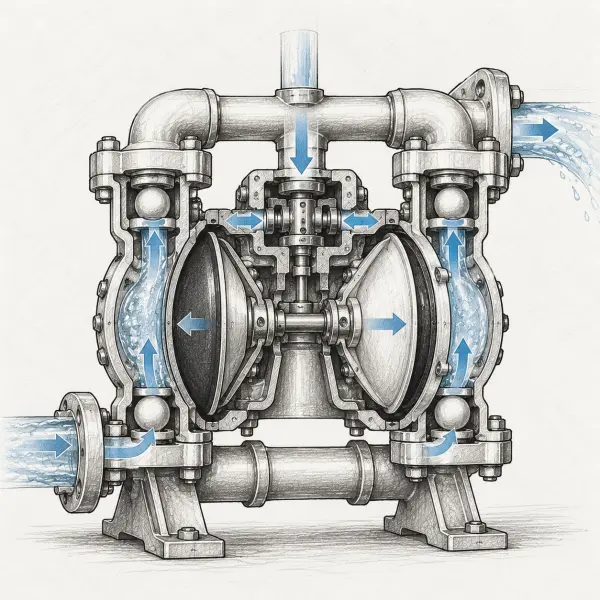
The diaphragms are at the center of the process. An AODD pump contains two flexible diaphragms connected by a common shaft. As compressed air pushes one diaphragm outward, the opposite diaphragm is pulled inward.
That movement creates the pumping action.
The pump also contains an air distribution system. An air valve directs compressed air from one side of the pump to the other, continuously alternating which diaphragm receives air pressure. This keeps the diaphragms moving back and forth as long as the pump receives an adequate supply of compressed air.
On the fluid side are check valves, commonly using balls and seats. These act almost like one-way doors.
As one diaphragm moves and creates suction, fluid enters the pump through the inlet manifold. The check valves help ensure that fluid travels in the correct direction. When the diaphragm reverses direction, that fluid is pushed toward the discharge manifold while the opposite chamber begins filling.
The process repeats continuously:
Fluid enters one chamber.
Fluid leaves the other.
Then the two sides switch jobs.
This alternating action is where the “double diaphragm” portion of the name comes from.
Although the operating principle is similar across the category, the actual construction of an AODD pump can vary significantly depending on what the pump needs to handle.
Why Materials Matter So Much
Understanding how an AODD pump operates is only half of understanding the technology.
What the pump is made from can be just as important.
The fluid being transferred comes into contact with several internal components, commonly referred to as the pump's wetted components. Selecting appropriate materials helps ensure those components are compatible with the fluid and operating environment.
Pump bodies and wetted components can be manufactured from materials such as stainless steel, aluminum, polypropylene and other engineered materials depending on the pump design.
The diaphragms, balls, seats and other internal components can also be offered in different elastomers and materials. Options may include Buna-N, EPDM, PTFE and other compounds designed for particular chemical, temperature, abrasion or application requirements.
This is why two pumps that appear nearly identical from the outside can be intended for very different jobs.
An AODD pump transferring water doesn't necessarily require the same materials as one transferring a corrosive chemical, abrasive slurry or viscous product.
Manufacturers such as Wilden Pumps and Yamada Pumps offer numerous material and configuration options so an AODD pump can be matched more closely to its intended application.
Material compatibility should always be verified before selecting a pump. Choosing the wrong wetted materials can shorten component life, affect pump performance or result in premature failure.
Why AODD Pumps Are Used for So Many Applications
The basic design of an AODD pump creates several characteristics that make the technology useful across industrial applications.
Because compressed air powers the pump, an AODD pump does not require an electric drive motor at the pump itself. Depending on the model and application, AODD pumps can also handle fluids containing solids, viscous products, abrasive materials and aggressive chemicals.
Many AODD designs are self-priming and can tolerate operating conditions that would be challenging for some other pump technologies. Flow can also be adjusted by controlling the air supply.
Another important advantage is versatility.
A manufacturer may offer the same general pump technology in multiple sizes, body materials, diaphragm materials and connection configurations. Instead of designing an entirely different pumping principle for every fluid, the pump can often be configured around the application.
That flexibility has helped make air-operated double-diaphragm pumps common in chemical processing, manufacturing, water and wastewater treatment, mining, food and beverage processing and general industrial fluid transfer.
Of course, versatility doesn't mean every AODD pump works for every application. Flow requirements, pressure, fluid viscosity, solids, temperature, chemical compatibility and available compressed air should all be considered when selecting equipment.
Simple Technology, A Lot of Possibilities
An AODD pump may look complicated from the outside, but its operating principle is surprisingly straightforward.
Compressed air moves two diaphragms.
The diaphragms create suction and discharge.
Check valves control the direction of the fluid.
And the cycle repeats.
What makes today's AODD technology impressive isn't necessarily the complexity of that process. It's the number of applications that can be addressed by changing the size, materials and configuration of the pump.
At Pumping Solutions, we carry a wide selection of AODD pumps, along with AODD pump repair kits, replacement parts and accessories for industrial fluid-handling applications.
Our selection includes equipment from manufacturers such as Wilden Pumps and Yamada Pumps, giving customers access to different sizes, materials and configurations for a wide range of pumping requirements.
Whether you're replacing an existing diaphragm pump, looking for repair components or selecting equipment for a new application, understanding what's happening inside the pump is a good first step toward choosing the right solution.
Because when the right components, materials and pump come together, a surprisingly simple idea can keep some very complicated processes moving.